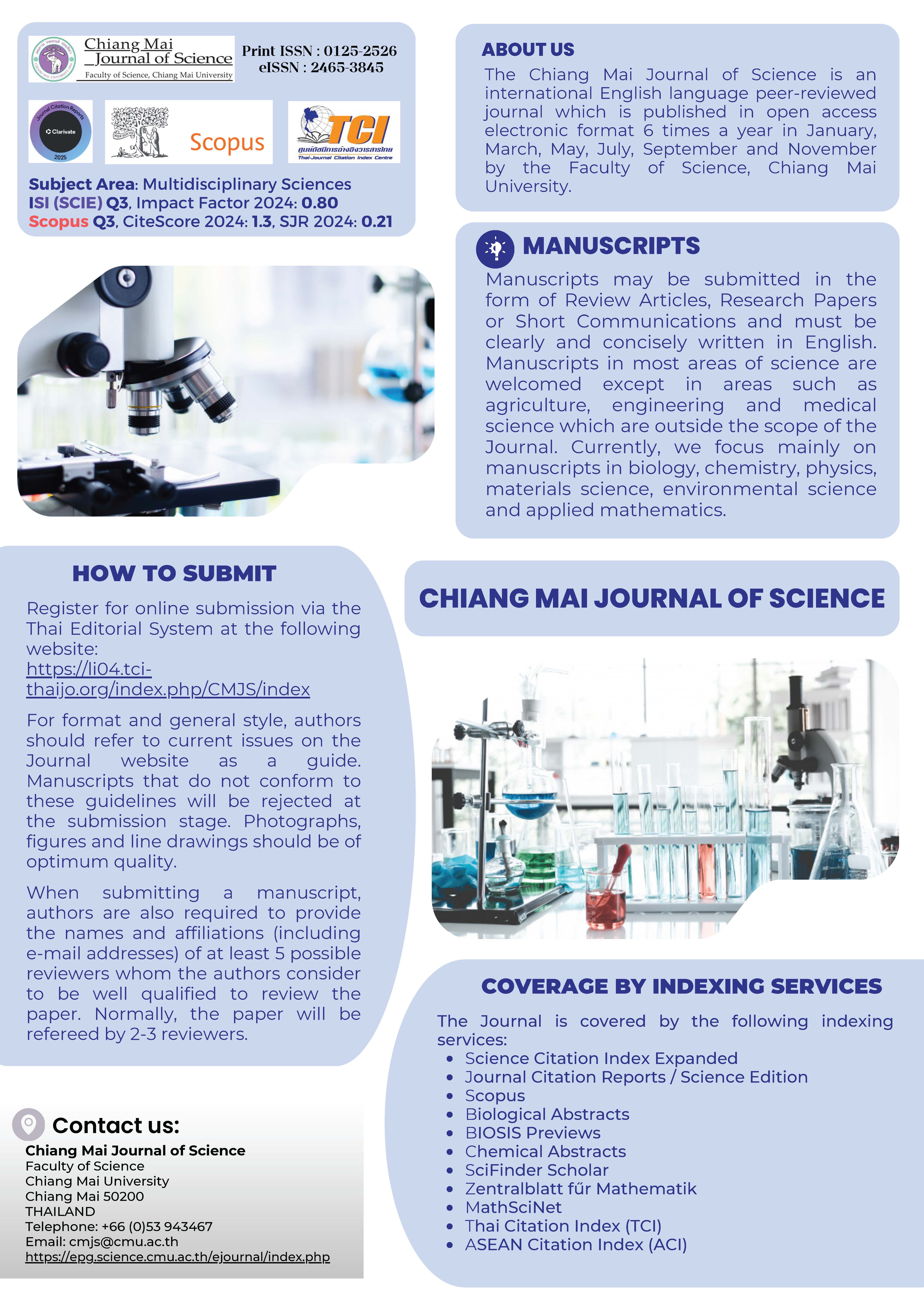
Print ISSN: 0125-2526 | eISSN : 2465-3845

Hongyan Wei, Tianbing Xu, Nuowen Hu, Zongkai Han and Tiehong Song*
Vol.53 No.6 (November 2026: In progress)
Natakorn Premwattananarakul, Anak Khantachawana, Phacharaphon Tunthawiroon, Aphinan Phukaoluan* and Kasama Srirussamee
Vol.53 No.6 (November 2026: In progress)
Panyawat Haarsa
Vol.53 No.6 (November 2026: In progress)
Pragatheeswari Ravi†, Sarojini Velayuthan Pillai*, Hussain Alathlawi, Hala Siddiq, Gino Daisyvictorial Johnwel and Sasi Florence Shanmugaraj*
Vol.53 No.6 (November 2026: In progress)
Piyasak Akcaboot, Chumphol Yunphuttha, Wantana Klysuban, Pensri Bunsawansong, Supatta Midpanon, Montida Raoarun, Attera Worayingyong and Pinsuda Viravathana*
Vol.53 No.6 (November 2026: In progress)
Haoyi Zhang , Pengyu Xu*, Tianhao Yang, Zhongsheng Chen, Hao Zheng and Ketong Liu*
Vol.53 No.6 (November 2026: In progress)Sarunya Phunpee [a], Satit Puttipipatkhachorn [b], Uracha Rungsardthong Ruktanonchai*[a]
Vol.40 No.6 SPECIAL ISSUE 2Xu Peng, Yuting Xu, Qinghua Liu, Weihong Wu, Qinwei Zhou and Li Fu*
Vol.47 No.6 (November 2020)Suphat Kamthai
Vol.34 No.1 (JANUARY 2007)Juntima Chungsiriporn, Prukraya Pongyeela, Nirana Chairerk, Jutarut Iewkittayakorn and Wiriya Duangsuwan
Vol.50 No.6 (November 2023)Wantana Koetniyom, Yossawas Nopjinda, Romechalee Tepnok, Nattaya Tosangthum, Monnapas Morakotjinda, Thanyaporn Yotkaew, Pongsak Wila and Ruangdaj Tongsri*
Vol.47 No.4 (Special Issue II : July 2020)